Key Takeaways
- Companies using built-in collaboration report 40% better team alignment and 25% faster decision-making than those using standalone tools.
- The average employee loses 2-3 hours daily to context switching between disconnected communication tools.
- Built-in collaboration eliminates integration maintenance costs that average $5,000-$15,000/year for mid-sized companies.
- The trend is clear: unified platforms with native collaboration are replacing best-of-breed tool stacks.
The Built-In Advantage
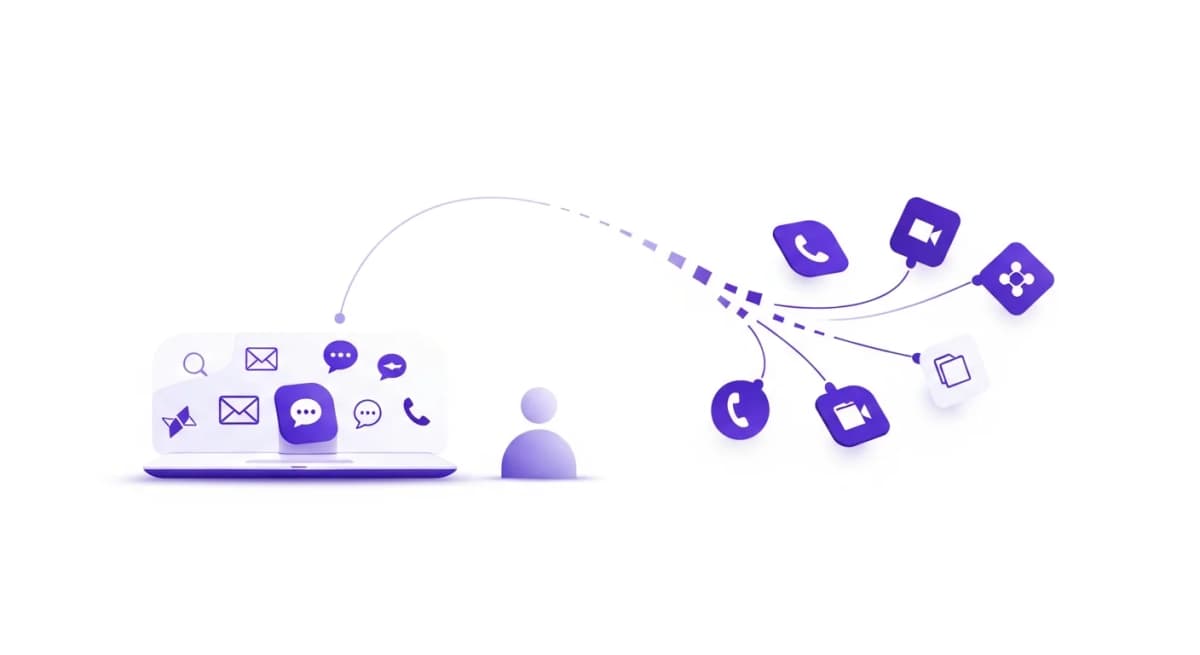
There's a fundamental architectural difference between collaboration tools that are built into your business platform and those bolted on through integrations. Built-in tools share the same database, the same user interface, and the same context. Information flows naturally without API connections, sync delays, or data translation.
Companies that have switched from standalone collaboration tools to built-in alternatives report measurable improvements: 40% better cross-team alignment, 25% faster decision-making, and 30% reduction in meetings needed to share information.
The Context Problem with Standalone Tools
When you discuss a hiring decision in Slack, the candidate's profile lives in Greenhouse. When you talk about team performance in Teams, the data lives in BambooHR. When you plan a project in Zoom, the tasks live in Asana.
This context fragmentation means every conversation requires participants to either have multiple tools open simultaneously or to manually copy information between systems. Both approaches are inefficient and error-prone.
Built-in collaboration solves this at the architecture level. In Alexia.ai, when you discuss a candidate in Team Connect, their recruitment profile is right there. When you talk about goals, the real-time data is visible. Context is always present because everything lives in the same system.
The Integration Tax
Standalone tools require integrations to share data. These integrations come with real costs:
Setup costs: Configuring integrations between Slack, your ATS, your HRIS, and your project management tool takes 10-40 hours of technical work.
Maintenance costs: When any tool updates its API - which happens quarterly on average - integrations break. Someone on your team spends time diagnosing and fixing these breaks. Mid-sized companies report spending $5,000-$15,000/year on integration maintenance.
Reliability costs: Even well-maintained integrations have sync delays, data inconsistencies, and occasional failures. Information that's 5 minutes stale in a fast-moving hiring process can mean losing a candidate.
Built-in collaboration has zero integration tax. There's nothing to set up, nothing to maintain, and nothing to break.
Stop reading about AI reporting. Start using it.
See how Alexia.ai automates the exact workflows covered in this article.
Security and Compliance Benefits
Every standalone tool in your stack is a separate security surface to manage. Each requires its own user provisioning and deprovisioning, access controls, data retention policies, and compliance monitoring.
When an employee leaves, you need to revoke access across 5-7 different tools - Slack, Zoom, Google Drive, your ATS, your HRIS, and more. Miss one and you have a security exposure.
Built-in collaboration means one system to secure, one set of access controls, and one deprovisioning action. Employee offboarding that takes 30 minutes across standalone tools takes 2 minutes in a unified platform.
Making the Switch
Transitioning from standalone tools to built-in collaboration doesn't have to be all-or-nothing. Many companies start by identifying their highest-friction workflows and consolidating those first.
Recruitment communications are often the best starting point. Moving hiring discussions from Slack into a platform like Alexia.ai - where candidate data is natively connected - produces immediate productivity gains.
HR communications are the natural next step. Team announcements, policy updates, and employee engagement activities work better when connected to people data.
The companies seeing the biggest returns are those that committed to full consolidation - replacing Slack, Zoom, and standalone HR tools with a unified platform. The upfront transition effort pays back within 3-6 months through reduced costs and improved productivity.

About the Author
Simon Jones
Co-Founder, Teamified
Simon is the Co-Founder of Teamified, where he helps businesses scale by connecting them with high-performing global talent. His expertise lies in optimising remote team management, ensuring companies can hire, manage, and pay contractors seamlessly across 150+ countries. With over two decades of experience in FinTech, SaaS, and outsourcing, Simon has co-founded multiple successful ventures, including Assembly Payments and Lazu. His deep understanding of technology, payments, and operational efficiency enables him to support businesses in building high-performing outsourced teams while driving cost efficiencies. Since launching Teamified, Simon has been a trusted partner for companies looking to expand their onshore operations with a smarter, faster, and more strategic approach to outsourcing.
Connect on LinkedInTry Alexia.ai's Built-In Collaboration
Communication connected to your business - no standalone tools needed.